Showing posts with label nevi moles. Show all posts

Wednesday, September 19, 2012

Can you Prevent Melanoma?

There are many risk factors for developing melanoma. The risk factor you can best control to reduce your risk of melanoma is exposure to ultraviolet (UV) radiation from the sun. Some experts believe that 65% or more of melanoma is caused by exposure to the sun, especially during childhood.

Do the following to help prevent skin cancer. Protect your skin. Stay out of the sun during the midday hours (10 a.m. to 4 p.m.). Wear protective clothing. This includes a hat with a brim to shade your ears and neck, a shirt with sleeves to cover your shoulders, and pants. The best fabric for skin protection has a tight weave to keep sunlight out.

Use daily a sunscreen with an SPF of at least 15. Look for a sunscreen that protects against both types of ultraviolet radiation in the sun's rays-UVA and UVB. Use a higher SPF when you are at higher elevations. Set a good example for your children by always using sunscreen and wearing protective clothing.

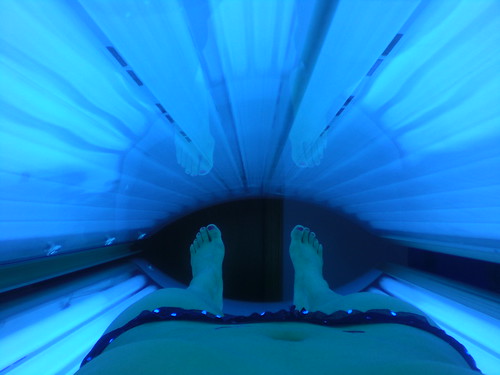
Avoid sunbathing and tanning salons. Studies suggest that UV rays from artificial sources such as tanning beds and sunlamps are just as dangerous as those from the sun. Examine your skin regularly, and have your doctor check your skin during all other health exams, or at least once a year.

People who live in warm, sunny climates or who have jobs that require them to be outdoors most of the time have a higher risk of developing melanoma. People who burn rather than tan, especially those who have red hair or blue eyes, also have a high risk and should take extra precautions to prevent melanoma.

Some people feel that a tan may protect against a sunburn and thus protect against skin damage and skin cancer. But if you do not tan easily, the amount of sun exposure needed to get a tan will cause excessive skin damage and outweigh any possible benefit from having a tan. Check your skin every month for odd marks, moles, or sores that will not heal.

Pay extra attention to areas that get a lot of sun, such as your hands, arms, and back. Ask your doctor to check your skin during regular physical exams or at least once a year. Even though the biggest cause of melanoma is spending too much time in the sun, it can be found on parts of your body that never see the sun.

Plant medicine is a very vast field and new discoveries are constantly coming to light. CURED's background is in biochemistry specializing in the field of medicinal plants and evidence based natural medicine. This has allowed them to develop specialized and incredibly effective remedies, available to health practitioners and the general public with guaranteed results.

Wednesday, September 12, 2012

Symptoms of Melanoma

The most important warning sign for melanoma is any change in size, shape, or color of a mole or other skin growth, such as a birthmark. Watch for changes that occur over a period of weeks to a month. Use the ABCDE rule to evaluate skin changes, and call your health professional if you have any of the following changes.

A is for asymmetry. One half of the mole or skin growth doesn't match the other half. B is for border irregularity. The edges are ragged, notched, or blurred. C is for color. The pigmentation is not uniform. Shades of tan, brown, and black are present. Dashes of red, white, and blue add to the mottled appearance.

Changes in color distribution, especially the spread of color from the edge of a mole into the surrounding skin, also are an early sign of melanoma. D is for diameter. The mole or skin growth is larger than 6mm or about the size of a pencil eraser. Any growth of a mole should be of concern. E is for evolution. There is a change in the size, shape, symptoms, surface, or color of a mole.

Signs of melanoma in an existing mole include changes in the following aspects. (1) Elevation, such as thickening or raising of a previously flat mole. (2) Surface, such as scaling, erosion, oozing, bleeding, or crusting. (3) Surrounding skin, such as redness, swelling, or small new patches of color around a larger lesion. (4) Sensation, such as itching, tingling, or burning. (5) Consistency, such as softening or small pieces that break off easily.

Many other skin conditions have features similar to those of melanoma. Melanoma can develop in an existing mole or other mark on the skin, but it often develops in unmarked skin. Although melanoma can grow anywhere on the body, it often occurs on the upper back of men and women and on the legs in women.

Less often, it can grow on the soles, palms, nail beds, or mucous membranes that line body cavities such as the mouth, the rectum, and the vagina. On older people, the face is the most common place for melanoma to grow. And in older men, the most common sites are the neck, scalp, and ears. They are so common that they have a wide range of classifications.

Later signs of melanoma include a break in the skin or bleeding from a mole or other colored skin lesion, and pain in a mole or lesion. Symptoms of metastatic melanoma may be vague and include: swollen lymph nodes, especially in the armpit or groin; a colorless lump or thickening under the skin; unexplained weight loss; gray skin; ongoing cough; headaches; seizures.

Call your doctor immediately if you have been diagnosed with melanoma; you have difficulty breathing or swallowing; you cough up or spit up blood (hemoptysis); you have blood in your vomit or bowel movement ; your urine or bowel movement is black, and the blackness is not caused by taking iron or Pepto-Bismol.

Laser and electrocautery treatments are not always effective because they only reach the outermost layers of the skin, while moles penetrate very deep into the dermal tissue, often beyond the reach of these treatments. Surgery, the other option doctors commonly offer, involves cutting out the mole

Best Online Deals